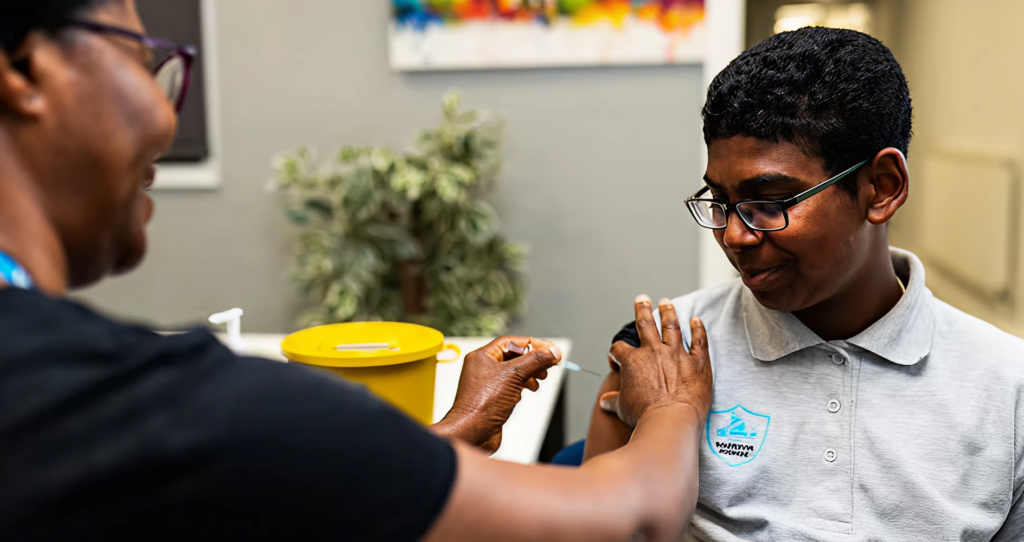
HPV Vaccine helps prevents more than one type of cancer
HPV vaccination protects against the types of HPV that cause most cervical cancers, as well as throat, anal, penile and vaginal cancers affecting people of all genders.
Protection works best when given early
The vaccine is most effective when given before exposure to HPV, which is why it is offered during the school years.
It provides long-lasting, safe protection
The HPV vaccine has been used globally for many years and is closely monitored for safety, providing long-term protection with only mild, short-term side effects for most people.

Part of the NHS School Aged Immunisation Service
HPV (Human Papillomavirus) causes around 9,000 cancers each year in the UK, most of which can be prevented by having the HPV vaccine. HPV is responsible globally for 5% of all cancers.
HPV is a very common virus that can be passed from person to person through close skin-to-skin contact. Most people who get HPV don’t have any symptoms and the infection often goes away on its own. However, some types of HPV can cause health problems later in life, including certain cancers. Vaccination helps protect against these harmful types before exposure occurs.
Gardasil activates the immune system to produce antibodies against 9 types of HPV (human papilloma virus). It does this by pretending to look like the virus. The vaccine does not contain any of the virus itself. It is highly effective and is endorsed by the World Health Organisation (WHO).
More than 270 million doses have been given globally and up to 60 million doses were given in 2020 alone, with no serious adverse events linked to the HPV vaccine and with an excellent safety profile. Extensive data on the safety of HPV vaccines is available from clinical trials and population programmes.
What does the HPV vaccine protect against and why is it important?
In females: cervical cancer, vulvar and vaginal cancer, anal cancer, genital warts, cancers of the head and neck such as throat and oral cancers.
In males: it protects against anal cancer, genital warts, penile cancer and cancers of the head and neck such as throat and oral cancers.
Why is my child offered the HPV vaccine at school?
The vaccine works best when given at age 12-13, when the immune system is strong and before your son or daughter becomes sexually active.
Almost 90% of people get HPV infection if they are not vaccinated and there is no treatment for HPV infection. Most people’s immune systems are able to clear HPV viruses in about 12 months and most people who catch HPV don’t even know they have it. However, there are some types of HPV infection that can persist for decades, and these are the types that can cause cancers in both women and men. So, vaccinating people against HPV protects them from cancers caused by some types of HPV that don’t clear up on their own.
HPV vaccine for boys
Boys can also be affected by certain HPV-related cancers and diseases like anal cancer and genital warts in later life.
In 2019 the HPV National Immunisation Programme was extended to include boys born AFTER 1st September 2006 up until their 25th birthday.
Also, there are no HPV screening programs for men, and usually no symptoms of the virus, so HPV infection can remain undetected in men.
The HPV vaccine is given in year 8 in the UK.
In 2023 the UK moved to a one dose schedule after data showed that the same 99% efficacy is achieved. Older siblings do not need to get catch up doses in the previous schedule.
The HPV vaccine is given as an injection into the upper arm. The vaccine is quick and safe, and temporary side effects are usually mild, like a sore arm or slight fever.
The HPV vaccination is very safe.
The HPV vaccine has been given since 2007 -The vaccine underwent over 15 years of research and clinical trials before being approved for public use. Over 280 million doses have been safely given, in more than 130 countries.
The Global Advisory Committee on Vaccine Safety considers HPV vaccines to be extremely safe
No concerns found through many very large, high-quality studies
The HPV vaccine is very safe for children. Common side effects are usually mild and short-lived, including a sore or red arm, slight swelling, mild fever, or headache. Serious side effects are extremely rare, and the benefits of protection against HPV-related cancers far outweigh these mild reactions.
HPV vaccination in the UK does not contain pork or gelatine.
If your child does not receive the HPV vaccine at school, they can still get it later through their doctor, local clinic, or public health service. The vaccine is most effective when given before exposure to HPV, so it’s best to arrange vaccination as soon as possible.
‘Encourages early sexual activity’
No evidence supports this claim. The vaccine focuses solely on health protection.
‘It’s only needed for girls’
The vaccine protects men and women against certain cancers and genital warts.
Offered to everyone since 2019.
‘The vaccine isn’t safe’
Over 280 million people have been safely vaccinated worldwide(2006-2022).
‘Children are not sexually active so there is no need to vaccinate them early’
It is important that young people build immunity against HPV BEFORE they are exposed to it.
‘My child will get a mild case of HPV when they receive the vaccine’
It is NOT possible for anyone to become infected with HPV as there is no live virus in the vaccine.
‘HPV is uncommon, and infection is unlikely’
80% people will have HPV during their life, many without symptoms.
In the UK, consent for school vaccinations is guided by both parental responsibility and a young person’s own rights, and this approach is supported by UK law.
Parents or those with parental responsibility are usually asked to provide consent for children to receive vaccinations in school. However, under the legal principle of Gillick competence, established in case law, a child under 16 may consent to their own medical treatment, including vaccinations, if a healthcare professional assesses that they have sufficient understanding and maturity to fully understand the benefits, risks, and implications of the vaccine.
This assessment is made on an individual basis. It is lawful for healthcare professionals to rely on a young person’s consent where they are assessed as Gillick competent. Wherever possible, we encourage open discussion between young people and their parents or carers, but if a child is deemed Gillick competent, their consent can be sufficient for vaccination.
We are passionate about protecting children’s health and supporting schools to create safer, healthier learning environments.
By working proactively with schools and families, we help ensure:
Useful Links:
Visit our YouTube page for a HPV FAQs and myth busting webinar:
Find NHS information on the HPV vaccine here:
https://www.nhs.uk/conditions/vaccinations/hpv-human-papillomavirus-vaccine
Find NHS ‘A Guide to HPV’ in British Sign Language here:
https://www.nhsinform.scot/translations/languages/british-sign-language-bsl/hpv-vaccine
Teenage immunisations for ages 14 to 18 (English and translations):
https://vk.ovg.ox.ac.uk/vk/hpv-vaccine
 EN
EN 


