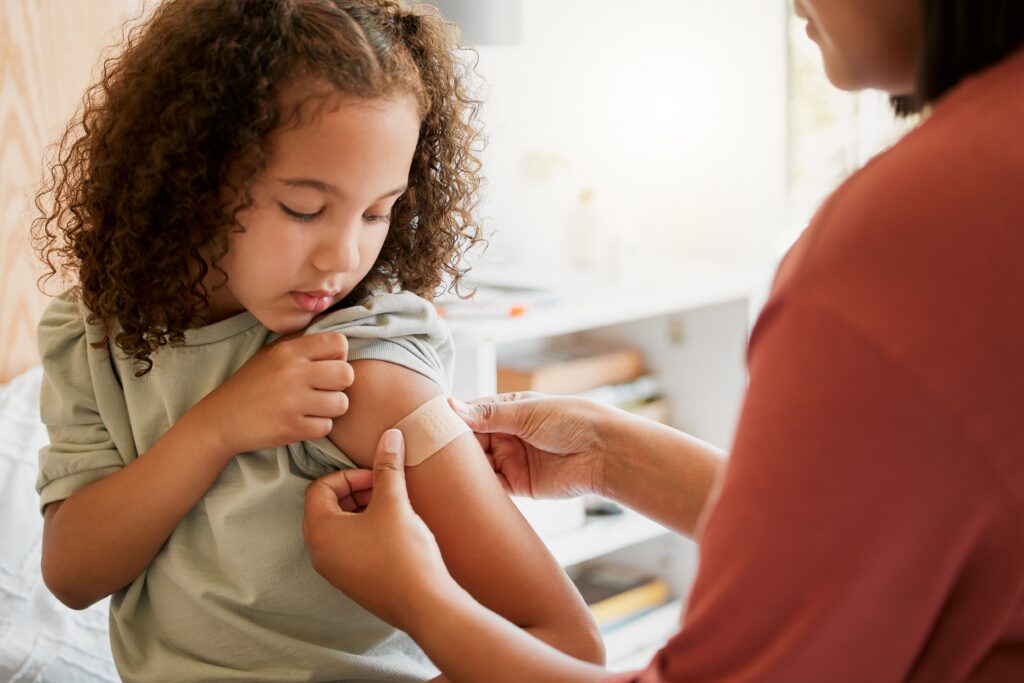
Measles, mumps and rubella are highly contagious viral infections that can cause serious health problems.
Although some people think measles is a mild childhood illness, it can lead to complications such as:
Globally, over 100,000 people die from measles every year, most of them children under the age of five.
Measles can also be fatal in the UK. Between 2000 and 2022, 23 children and adults died in England and Wales due to measles or related infections.
Vaccination is the best way to protect children and prevent these illnesses spreading.

Part of the NHS School Aged Immunisation Service
Cases of measles have increased in England in recent years.
Reported cases in England and Wales include:
Millions of children are also not fully protected. The NHS estimates that more than 3.4 million children under the age of 16 in England are not fully vaccinated against measles.
Because measles spreads so easily, outbreaks can happen quickly when vaccination rates fall.
Measles is one of the most infectious diseases in the world.
In an unvaccinated population, one person with measles can infect more than 15 others, meaning outbreaks can grow very quickly.
For comparison, public health experts aimed to keep the COVID-19 transmission rate below 1.
When 95% of people are vaccinated, the spread of measles drops dramatically and outbreaks are much less likely.
What is measles?
Measles is a highly infectious viral illness that spreads through the air when an infected person coughs or sneezes.
Symptoms usually begin with:
A few days later a red or brown rash appears, usually starting on the face and spreading across the body.
Although many children recover, measles can lead to serious complications including pneumonia, seizures and inflammation of the brain. Vaccination provides strong protection against infection.
What is mumps?
Mumps is a viral infection that mainly affects the glands around the jaw and neck.
Common symptoms include:
The swelling around the cheeks and jaw can give the appearance of a “hamster-like” face.
Although most people recover, complications can occasionally occur, including meningitis or inflammation of the testicles or ovaries.
What is rubella?
Rubella (also known as German measles) is usually a mild illness in children, but it can be very dangerous during pregnancy.
Symptoms may include:
If a pregnant woman catches rubella, it can cause miscarriage or serious birth defects, which is why vaccination is so important for protecting the wider community.
The MMR vaccine protects against measles, mumps and rubella in a single injection.
The vaccine works by helping the immune system recognise and fight these viruses if the body is exposed to them in the future.
It does not contain the live viruses in a form that can cause the diseases and has been used safely in the UK for many years and is one of the most effective vaccines available.
Millions of children worldwide receive the MMR vaccine every year as part of routine immunisation programmes.
In the UK, the MMR vaccine is normally given in two doses:
Two doses are needed for the best protection.
If a child has missed one or both doses, they can still receive the vaccine later through catch-up vaccination programmes.
The MMR vaccine is given as a quick injection into the upper arm or thigh.
Appointments usually take only a few minutes, and children can return to their normal activities afterwards.
Yes. The MMR vaccine has an excellent safety record and has been used worldwide for many decades.
It has been carefully tested and continuously monitored to ensure it remains safe and effective.
Millions of children receive the vaccine every year as part of routine immunisation programmes.
Most side effects are mild and temporary.
Common side effects may include:
Some children may develop a mild rash a few days after vaccination.
Serious side effects are very rare, and the benefits of protection against these diseases greatly outweigh the risk of mild side effects.
If your child has missed one or both doses of the MMR vaccine, they can still receive it.
Catch-up vaccinations are available through:
It is never too late to be vaccinated.
Measles usually begins with cold-like symptoms before the rash appears. Symptoms normally develop 7 to 14 days after infection.
Early symptoms may include:
After a few days, small white spots may appear inside the mouth, followed by a red or brown rash.
The rash usually:
The rash may look different depending on skin tone, but it usually feels slightly rough to the touch.
Measles is infectious from around four days before the rash appears until four days afterwards, which means it can spread easily before it is recognised.
If you think your child may have measles:
Most children recover fully, but medical advice is important to prevent the infection spreading to others.
If yThe best protection against measles is two doses of the MMR vaccine.
When most people in a community are vaccinated, it helps prevent outbreaks and protects those who cannot be vaccinated, including babies and people with weakened immune systems.
Measles is just a mild childhood illness
Measles can cause serious complications including pneumonia, meningitis and inflammation of the brain. In rare cases, it can be fatal. Vaccination is the best protection.
The MMR vaccine causes autism
The MMR vaccine does not cause autism. The claim came from a study published in 1998 that has since been fully discredited and withdrawn. Numerous large studies around the world have found no link between the MMR vaccine and autism.
Natural immunity is better than vaccination
Catching measles, mumps or rubella can lead to serious complications. Vaccination provides protection without the risks of the disease.
We are passionate about protecting children’s health and supporting schools to create safer, healthier learning environments.
By working proactively with schools and families, we help ensure:
Useful Links:
For more information about the MMR vaccine:
NHS – MMR vaccine
https://www.nhs.uk/conditions/vaccinations/mmr-vaccine/
UK Health Security Agency – Measles information
https://www.gov.uk/government/collections/measles-guidance-data-and-analysis
Vaccine Knowledge Project – MMR vaccine
https://vk.ovg.ox.ac.uk/vk/mmr-vaccine
 EN
EN 


