Vaccination UK delivers a range of routine school vaccinations that protect against serious infectious diseases, including:
Each vaccine is offered at specific ages in line with UK guidance.
Flu (influenza) vaccine at school
What is the flu?
Flu is a contagious viral infection that can cause fever, cough, tiredness and complications in children.
Why is the flu vaccine important at school?
Schools are environments where flu spreads easily. Vaccinating children helps protect them and reduces spread to families and vulnerable people.
Who is offered the flu vaccine at school?
The flu vaccine is routinely offered to primary school children and some secondary school year groups.
How is the flu vaccine given?
Most children receive a nasal spray. Some may receive an injection if the spray is unsuitable.
When is the flu vaccine given?
Usually during the autumn term.
For more detailed information, see our flu vaccine for children overview.
Diphtheria, Tetanus and Polio (Td/IPV) vaccine at school
What is the Td/IPV vaccine?
This booster protects against diphtheria, tetanus and polio.
Why is it important at school?
It helps maintain immunity as protection from early childhood vaccines can reduce over time.
Who is offered the Td/IPV vaccine?
Usually offered to children in Year 9 (ages 13–14).
How and when is it given?
Given as a single injection, usually alongside the meningitis ACWY vaccine during the school year.
When is the flu vaccine given?
Usually during the autumn term.
For more detailed information, see our DTP & Meningitis ACWY vaccine for children overview.
Meningitis ACWY vaccine at school
What is meningitis ACWY?
A vaccine protecting against four strains of meningococcal bacteria that can cause meningitis and blood poisoning.
Who is offered this vaccine?
Typically offered to adolescents in Year 9 or 10.
How and when is it given?
Given as a single injection, often at the same session as the Td/IPV booster.
For more detailed information, see our DTP & Meningitis ACWY vaccine for children overview.
What is MMR?
A combined vaccine protecting against measles, mumps and rubella.
Who is offered MMR?
Children who have missed one or both doses earlier in childhood.
How is it given?
As an injection, usually during catch-up school sessions.
For more detailed information, see our MMR vaccine for children overview.
What is HPV?
HPV is a common virus that can lead to several cancers later in life.
Who is offered the HPV vaccine?
Boys and girls in Year 8 (ages 12–13).
How and when is it given?
Given as an injection during the school year.
For more detailed information, see our HPV vaccine for children overview.

School vaccinations help maintain protection as children grow older and immunity from early vaccines reduces over time.
High vaccination uptake helps protect your child, their classmates, and those in the community who cannot be vaccinated due to medical reasons.
Do children still need vaccines if they were vaccinated as babies?
Yes. Some school vaccines are booster doses needed to keep protection strong into adolescence and adulthood.
Are school vaccines optional and less important?
No. School vaccines are part of the UK routine immunisation programme because they protect against diseases that still pose a real risk.
Are too many vaccines given at once?
No. Vaccines offered together have been carefully tested and safely used for many years.
Parents or carers are asked to provide informed consent before vaccinations take place, usually via an online or paper consent form sent home by the school.
This process allows parents to review information, ask questions, and make an informed decision.
What is ‘Gillick Competence’?
In the UK, consent for school vaccinations is guided by both parental responsibility and a young person’s own rights, and this approach is supported by UK law.
Parents or those with parental responsibility are usually asked to provide consent for children to receive vaccinations in school. However, under the legal principle of Gillick competence, established in case law, a child under 16 may consent to their own medical treatment, including vaccinations, if a healthcare professional assesses that they have sufficient understanding and maturity to fully understand the benefits, risks, and implications of the vaccine.
This assessment is made on an individual basis. It is lawful for healthcare professionals to rely on a young person’s consent where they are assessed as Gillick competent. Wherever possible, we encourage open discussion between young people and their parents or carers, but if a child is deemed Gillick competent, their consent can be accepted for vaccination.
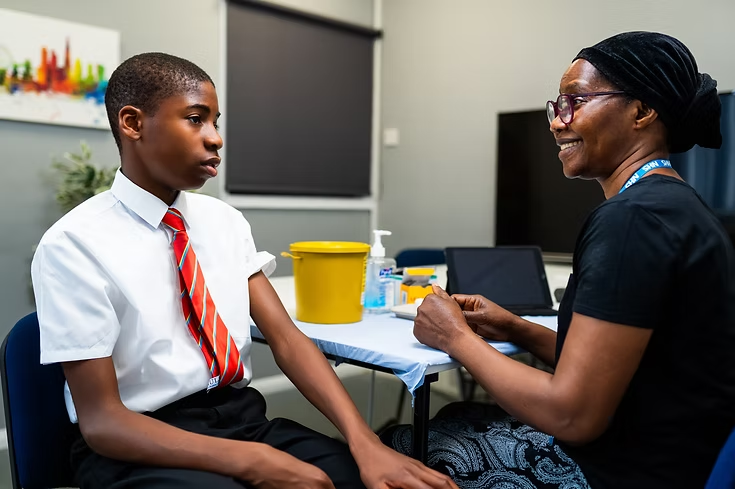
Vaccinations are delivered by trained healthcare professionals in a designated area of the school, with support provided throughout.
Catch-up clinics or alternative appointments may be offered.
You can contact Vaccination UK using the details provided with your consent information or via our website.
You will receive an email requesting a response – whether you choose to accept or decline the vaccination offer, it is important that you reply. Our system will continue to send reminders until we receive a response from you. You will also receive vaccine reminders in advance of the school session, these come by email and SMS.

Part of the NHS School Aged Immunisation Service

School Vaccines

Catch-up Clinics
Newborn Services
 EN
EN 


